SOVEREIGN AI PLATFORM
The platform layer for sovereign AI.
Substrate turns sealed, on-premise hardware into a working AI system: seven services behind one stable interface, with nothing leaving the enclosure.
SERVES LLAMA · QWEN · DEEPSEEK · MISTRAL · GEMMA · GPT-OSS · +4 MORE
BUILT AND SEALED BY ELEMENT 31
# Ground the answer in local documents. Cite every claim.
passages = substrate.retrieval.query(
    workspace="ops-north",
    query="What changed in the last maintenance cycle?",
)

reply = substrate.inference.generate(
    model=pins.reasoning, # pinned at provisioning
    context=passages,
    audit_tag="shift-briefing",
)

# Both calls are already in the local audit record.
THE BOUND SDK SHIPS WITH THE APPLIANCE.
WHAT IT IS
Applications above. Hardware below. Substrate in between.
Every serious on-premise AI deployment needs the same middle layer: somewhere for agents to keep state, a way to ground answers in your documents, model serving that survives hardware changes, tuning that does not export your data, and a record of everything the system did. Substrate is that layer, built once and built to be reviewed.
Your teams build against Substrate’s interfaces and bring the workflows and domain knowledge. The platform ships preinstalled and sealed, so the stack an accreditor reviews is byte-for-byte the stack that runs.
ARCHITECTURE
One stack, sealed together.
Each layer is named for what it does. Implementations are selected per deployment and are not part of the interface you build against.
SEVEN SERVICES
Everything a deployment needs. Nothing it has to trust blindly.
HOW TEAMS BUILD
From crate to production, in three moves.
STEP 01
Provision
The appliance arrives with Substrate sealed in. Workspaces, document corpus, model pins, and declared routes are configured against your policy — then the configuration is frozen into the record.
STEP 02
Build
Your teams develop against the seven service APIs. The interface is the contract: model families and hardware tiers can change underneath without an application rewrite.
STEP 03
Sustain
Signed bundles refresh the platform and models on your cadence — over the wire or across the gap on physical media. The audit surface stays continuous through every change.
WHERE IT RUNS
Sealed appliance or approved racks.
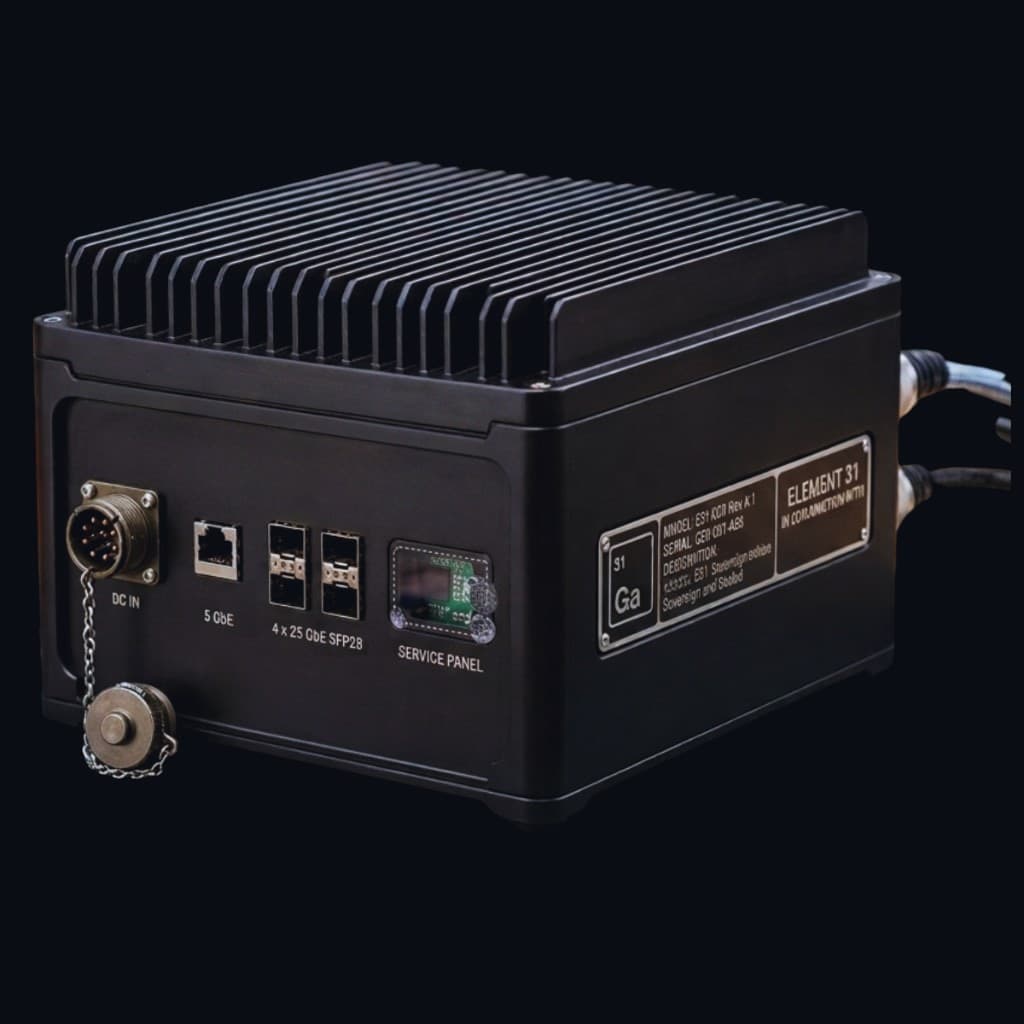
On the appliance.
Element 31 builds three sealed, air-gap-capable appliances on one architecture: Forge for coding, Czar for training and fine-tuning, and Chassis for built-to-order resale. Each ships with compute, storage, a tamper-evident enclosure, and Substrate provisioned as one reviewed unit.
See the hardware line on e31.ioOn your racks.
Where the hardware is already prescribed, Substrate deploys onto customer-approved systems: the same sealed images, the same signed update path, and the same audit surface, provisioned against your bill of materials.
Either way, the platform is identical. Applications built for one deployment carry to the next, and the security model — default-deny egress, continuous integrity verification, local audit — does not vary by footprint.
HOW TO ENGAGE